Guides · 17 July 2026 · Shop Simply
How to Start an Online Shop in South Africa (Step-by-Step Guide)
Starting an online shop in South Africa is more accessible today than it's ever been. You don't need a developer, a big budget, or months of planning. You need a product worth selling, a handful of admin basics sorted out, and a platform that handles the technical side for you.

This guide walks through the whole process — what to sell, how to register your business, how to accept payments, how to handle shipping, and how to get your first customers. Nothing here requires you to write a line of code.
1. Decide what you're selling — and who it's for
Before touching any platform or paperwork, get clear on two things: what you're selling and who's buying it.
The online shops that do well in South Africa tend to fall into a few buckets: a physical product you make or source yourself (crafts, food, beauty products, clothing), a product you distribute for other local brands, or a niche you understand better than the big retailers do. Trying to compete head-on with Takealot on price and range rarely works for a new, small shop — competing on niche, service, and personal trust usually does.
Spend time here before you spend money anywhere else. A shop with the wrong product, built perfectly, still won't sell. A shop with the right product, built simply, often will.
2. Register your business
You can technically start trading before formal registration, but sorting out the basics early avoids problems later — with SARS, with banks, and with suppliers who ask for company documents before they'll deal with you.
There are two common paths:
Sole proprietor.This is the simplest route and the one most people starting out use. There's no registration with the Companies and Intellectual Property Commission (CIPC) required — you trade under your own name (or a registered trading name) and are personally liable for the business. What you do need is to register as a provisional taxpayer with SARS, generally within 60 days of starting to trade. If you want a registered trading name without forming a company, you can reserve one through CIPC for a small fee.
Private company (Pty Ltd).This creates a separate legal entity, which limits your personal liability and looks more established to banks, suppliers, and some customers. Registration happens online through CIPC's BizPortal, costs around R175, and can be completed in as little as a day. You'll need a Memorandum of Incorporation, director details, and a registered address. Once registered, you'll also need to register the company with SARS for income tax.
On VAT: registration only becomes compulsory once your annual turnover crosses the compulsory threshold (R2.3 million, effective from 1 April 2026), or you can register voluntarily once turnover passes R120,000. Most new shops won't need to think about VAT registration in year one — but it's worth knowing the thresholds exist so you're not caught off guard as you grow.
This isn't legal or tax advice, and rules like these do change — confirm your specific situation with SARS, CIPC, or an accountant before you register.
3. Set up your online shop
This is where the technical side used to slow people down — and where a platform built for this exact job saves you the most time.
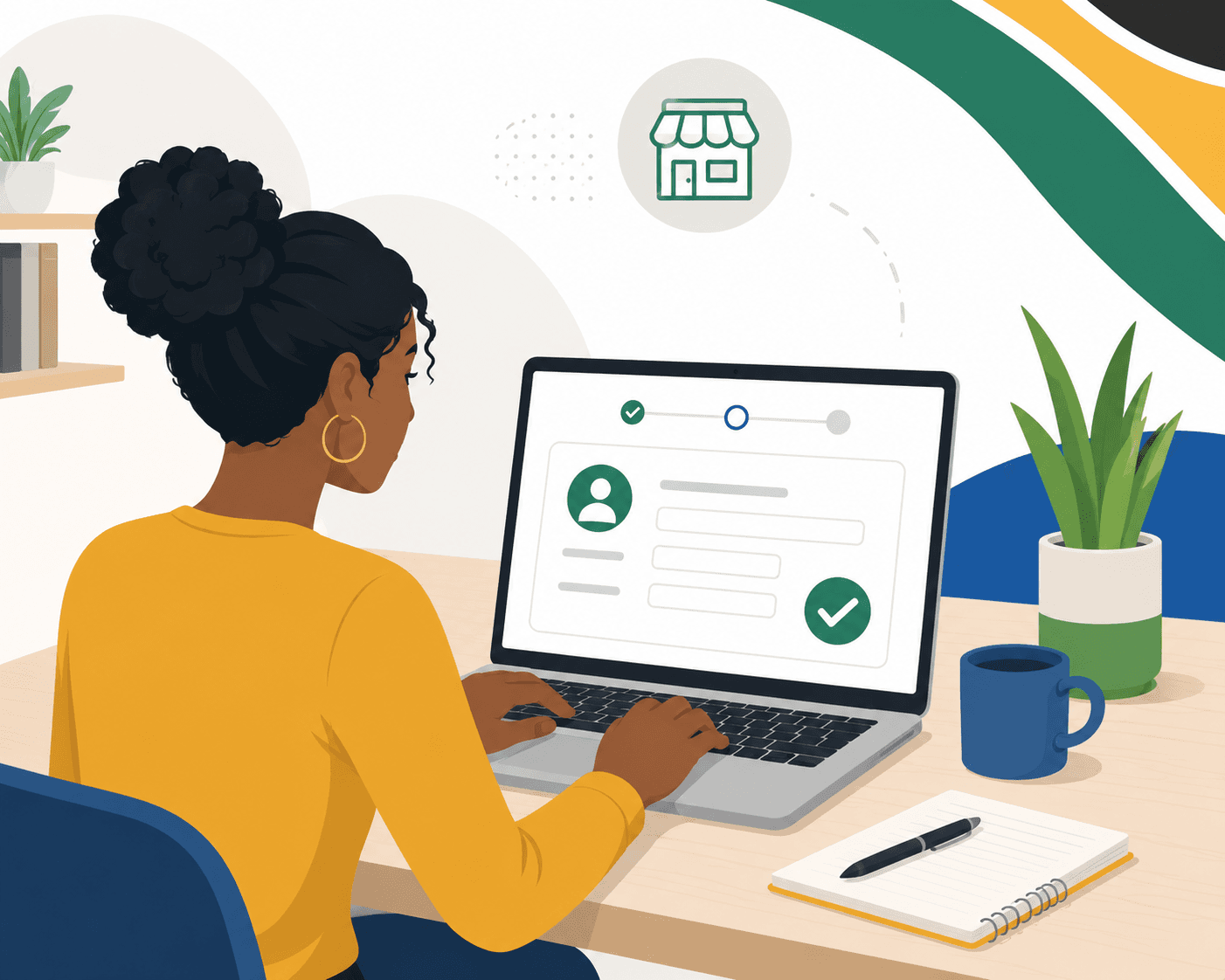
With Shop Simply, you sign up and build your shop for free: add your products, set your prices, upload photos, write your policies, and get everything looking the way you want — all in a private admin area only you can see. There's no code, no developer, and no waiting.
When you're ready to actually open to customers, you activate your shop for R89a month. That's what switches your shop from a private draft into a live storefront the public can visit, browse, and buy from. Once live, you can also connect your own custom domain instead of using the default shopsimply.co.za subdomain.
A few practical things worth knowing before you build: your shop's name and URL, your product categories, your return and shipping policy text, and clear product photos all matter more than a fancy design. Customers trust shops that look complete and answer their questions upfront — not shops with the flashiest layout.
4. Set up payments
You need a way to actually get paid, and this needs to work reliably from day one — a customer who can't check out is a lost sale, not a delayed one.
Shop Simply integrates with Payfast and Paystack, two of the most widely used payment gateways for South African online businesses — pick whichever suits you. Both support card payments, EFT, and popular local payment methods, and deposit funds into your bank account on a regular schedule. You'll need to set up your own account with whichever one you choose and link your bank details — the platform handles the checkout flow and transaction confirmation for you.
Decide upfront how you'll handle failed payments, refunds, and disputes. Write this into your shop's policies so customers know what to expect before they hand over their card details, not after.
5. Sort out shipping and delivery
Shipping is where a lot of new shop owners underestimate the admin. Decide early on:
Which couriers you'll use, and whether you'll offer more than one option. The Courier Guy, Pudo, and Aramex are common choices for small SA ecommerce shops, alongside local delivery for shops serving one city or region.
Whether shipping is a flat fee, free above a certain order value, or calculated by weight or location. Simpler pricing is easier for customers to understand and easier for you to manage in the beginning.
How you'll pack and label orders once they start coming in — even a simple system (a shelf, a checklist, a same-day-dispatch rule) prevents chaos once you're fulfilling multiple orders a day.
6. Get your first customers
You don't need a big ad budget to get your first sales. Before spending anything, work through the free channels:
Post in relevant Facebook groups for your area or niche — buy-and-sell groups, local community groups, or interest-specific groups where your product fits naturally. Share your shop on your own social accounts, and ask friends and family to do the same. Reach out directly to a handful of people who'd genuinely want your product and offer them a first look. Respond quickly to every comment and message — early trust is built one reply at a time.
Once you've made your first few organic sales, you'll have real product photos, real reviews, and a clearer sense of who your customer actually is — all of which make paid ads far more effective if you choose to run them later.
Start today
Setting up your shop costs nothing, and you can build it at your own pace before deciding to go live. Register your business basics in parallel, get your Payfast or Paystack account sorted, and you can realistically go from idea to your first sale within a couple of weeks.